|
|
 |
Lukas Ligeti Interview
Posted on 09 August 2007. © Copyright 2004-2026
Composition:Today
|
C:T talks to Composer-percussionist Lukas Ligeti, who is developing a style of music uniquely his own, drawing upon Downtown New York experimentalism, contemporary classical music, jazz, electronica, as well as world music, particularly from Africa.
 |
|
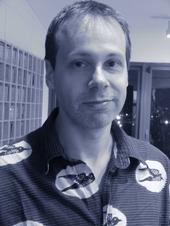
Lukas Ligeti
|
You were a late starter in composing - did having a famous composer father [Gyorgy Ligeti] mean you steered clear of the subject?
Yes, probably. But on the other hand, had my father not been a composer, would I ever have had the idea that composing could be a profession in the first place? Hard to say. When I was a child, my father often told me he thought I was musically talented, but my parents didn't force me into music in any way, and I didn't really want to learn music. I had a few piano lessons at about 9 years old, but quit after 3 months or so. In high school, I was into math and science. But when I was done with high school and had to think about what to do with my life, I had to admit to myself that I was always hearing music in my head.
What drives your work, what are you passions?
I spend lots of time thinking about music, and certain questions arise. Aesthetic questions, questions about history, of cultural identity, of perception. I imagine sounds, melodies, rhythmic relationships, and these fantasies raise questions. And I feel compelled to do something with these thoughts, to structure them somehow and meld them into pieces, and answer some of my questions, which in turn generates new questions.
Which non-musical influences have affected your music most?
Since childhood, I've traveled a lot. I went to international schools and my friends came from all over the world. I don't feel rooted in any one particular culture; I feel rooted in interculturalism. Also, other art forms - especially architecture and visual art, also literature - influence me, as does science, particularly experimental mathematics, physics, astronomy, and computer science. Sociology and politics affect my thoughts, too.
What do you see as the role (intended and actual) of new music in the modern world?
I create music independently of its social role - to me, music exists, first and foremost, for its own sake, and I am not a populist. However, communication and exchange with other human beings is very important to me. I want my music to give people food for thought, to make them think differently and outside of the box. While musical languages are by necessity abstract, I do think that music can be "understood". Giving listeners structures they can understand, each in their own individual way, leading them to new, creative thoughts, is an interesting challenge. I'm not sure that the status quo, of seeing every piece of music as an isolated phenomenon with a grammar all its own, necessarily contributes to the social significance some composers would like to new music to attain. I work a lot on collaborations with musicians in Africa and the way music is always connected to other art forms or social functions in Africa is an interesting model for comparison with new music's role in the West. From which numerous conclusions can be drawn.
Who or what has inspired you the most?
Hard to say - there are so many things, and so many people. My parents, my friends. Girlfriends. Cats. Musician colleagues. I have never been good with "thank you" notices, as so many experiences and emotions come into the mix. My exposure to many different cultures, from childhood on, has played a significant role.
What's the craziest idea for a piece you've ever had?
I've had tons of crazy ideas, many of which still remnain unrealized, so there are many to come. Years ago, I wrote a piece called Groove Magic, for 11 musicians all listening to individual click-tracks. Sometimes they play at 11 different speeds, and sometimes at the same tempo but staggered - however they are always perfectly in sync. I think it is the craziest polymetric ensemble piece ever written, with the fastest klangfarbenmelodien in music history. I've also developed a drumming style enabling me to play very long polymetric cycles, with patterns that last for 1000s of beats or, when using electronic percussion, even 1000s of years until they repeat!
I have also done much experimental music with African traditional musicians, mixing ancient African instruments and computers. This is apparently crazy, as almost no one else seems to do it.
Tell us something about your working method as a composer. Give us something that might be or might have been a starting point for a piece.
Often, I will start with a melodic idea, and in my imagination, I might just hear myself singing. Or I start with a visual idea, relationships between objects or shapes. Or just colors. Or a rhythmic idea. There are many possibilities; I don't have a set method. Every piece I write feels like learning how to compose all over again from scratch.
Tell us about your work routine. Do you have a place that's special? A preferred time of day?
I play drums and also do many other things aside from composing. But composing requires a level of concentration and immersion that is different from everything else. When I compose intensively, I try to avoid, as much as possible, any other activities, to maintain a high level of concentration. Once I achieve that, I can go for an enormously long time without sleep.
Special places...I live in Bushwick, a section of Brooklyn, New York. It's a very cool area, a bit dilapidated, but there's lots of underground cultural activity. From my apatrment, I have a view of the entire city, and it is truly a special place to work. I like working at home, being close to my electronic equipment, books and CDs and even TV. That's why I don't go to composition retreats or artist colonies. Another special place: various parts of Africa. I've developed an extremely strong emotional relationship to African culture, and take much inspiration from the time I spend there.
What are your plans for the future?
I have tons of ideas, much too many to realize. I want to continue composing and playing my music. There's always a lot to learn, and I hope that, over time, I'm getting better at it!
How can people find out more about you?
My website is http://www.lukasligeti.com, and my myspace page is http://www.myspace.com/lukasligeti. The myspace of one of my bands is
http://www.myspace.com/burkinaelectric. I also send out an occasional newsletter about my activities; you can reach me through my website and ask to be put on the mailing list, and you can find CDs on my website.
Interview by Composition:Today © Copyright 2004-2026
 Comments by other Members Comments by other Members
| |
|
|



