|
|
 |
Graham Ross Interview
Posted on 25 March 2008. © Copyright 2004-2026
Composition:Today
|
C:T talk to Graham Ross, composer and co-founder of The Dmitri Ensemble
 |
|
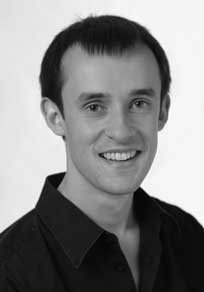
Graham Ross
|
Tell us something about your background.
I was born in Surrey to a musical family who helped nurture my initial musical interests. I sang as a treble chorister and studied piano, violin and organ, first locally, and then for three years as a Junior Exhibitioner at the Royal College of Music. I began to take composition lessons with David Sutton-Anderson, and in 2003 went up to Cambridge University to read Music at Clare College, where I conducted the University Symphony Orchestra and University Music Society alongside numerous other performing groups. It was here that I co-founded The Dmitri Ensemble with two fellow RCMJD students, based around the central core of a string ensemble. At Cambridge I studied composition with Giles Swayne, and began to have my works more widely performed in the UK. During my last year as an undergraduate I won the inaugural National Youth Choir of Great Britain composition competition, and subsequently became published by Novello & Co., and began to have works broadcast. In 2006 I returned to the Royal College of Music, this time as a postgraduate Masters conducting student, studying conducting with Peter Stark and Robin O’Neill, and composition with Timothy Salter, generously supported by an H.R. Taylor Trust Award for Conducting. In addition to my studies I hold a conducting scholarship with the London Symphony Chorus, and have worked with numerous ensembles and orchestras alike in repertoire from Buxtehude to the present day. I have had works performed in festivals and broadcasts in the UK and further abroad, as far afield as Lebanon, Kuwait, Slovenia, Israel and the USA, with performances given by, amongst others, Aurora Orchestra, Choir of Clare College, National Youth Choir of Great Britain, Choir of London, The Place Contemporary Dance School, English Voices, The Syred Consort, and The Dmitri Ensemble.
How did you get into composing?
I began composing in my early teens with small works and some attempts at larger-scale pieces. My musical upbringing was steeped in the English choral tradition, and so I frequently found myself naturally writing for the voice. At the RCM I began to experiment with new ideas, and thanks to the encouragement of my classes and the willingness of my contemporaries, I was able to discover new ideas about balance, instrumentation, colour, timbre and so forth. At Cambridge, my teacher Giles Swayne made a huge impact on me, giving me the inspiration and belief to develop my technique further, to focus on the issues raised by the compositional process, and to begin the process of attempting to gain an individual voice. The set-up at the University was second-to-none, and I had the luxury of having works rehearsed and performed on a regular basis by good, insightful, intelligent musicians who were not afraid to say what they thought. This for me was the most useful tool in my development as a composer, and still remains so today.
What drives your work, what are you passions?
All sorts of things inspire me, sometimes visual (artwork, architecture), sometimes literary (poetry), sometimes geographical (travel, juxtaposition of cultures), sometimes other composers’ works. I am interested in collective belief, and the power that music has to offer as a universal language that overcomes so many barriers. As a conductor, I relish the opportunity to work with other composers, presenting a fresh reading of a score as a collaborative effort. A lot of my own works to date have involved the human voice, and the ability to explore in particular different combinations of voices particularly interests me. I like to think that I am always open to new ideas, and keen to discover new potential avenues to explore musically.
Tell us something about your working method as a composer. Give us something that might be or might have been a starting point for a piece.
The result of combining conducting and composing is that in practical terms it is rarely possible to successfully engage in both simultaneously. Despite bouncing off one another rather well, they are usually project-based disciplines, both of which are time-consuming activities. But this for me is a great advantage: I often find myself with a good deal of thinking time during the inactive hours of a conducting project, and this allows me to focus on plans for the next commission. If setting a text, it takes me a great deal of time to select one that works well for me, sometimes as long as the actual compositional process itself. But once I have identified one (it always text before music for me) and lived with it for some time, I find the process of writing the work relatively straightforward, and one that I find difficult to interrupt. I need to clear time in the diary to ensure that I don’t have to disrupt the flow of writing. The ability to fully plan and structure a work in my head before I commit pen to paper is important for me.
Tell us about the Dmitri Ensemble, how it was formed, and its raison d'être.
I co-founded The Dmitri Ensemble during my first year at Cambridge University with two fellow students from the RCMJD. Based around the central core of a string ensemble, the group came together to perform both stalwarts of the repertoire and lesser-familiar works, and has since given first performances in Cambridge and London, where the group is now based.
Does the group focus on playing specific types of music?
The Ensemble performs in particular works that are newly-penned or works that we feel have been unjustly neglected. As such, previous performances have included lesser-known works by William Alwyn, Bruce Montgomery and Gustav Holst, as well as arrangements such as Rudolf Barshai’s arrangement of Shostakovich’s String Quartet no. 8, from which the Ensemble takes its name. The group has worked closely alongside Giles Swayne and James MacMillan, as has also given the first performances of a number of my own works, including …supersitions… for chamber ensemble, and Crossing Brooklyn Ferry for mezzo-soprano, harp and double string orchestra.
Tell us about the Ensemble’s current projects.
The Ensemble has recently embarked on a major project of new works for Passiontide: touring James MacMillan’s rarely-performed chorus version of his motet …here in hiding…alongside Giles Swayne’s Stabat Mater for unaccompanied choir and solo quartet, written in 2003 and dedicated to the grieving mothers of Israel and Palestine, and culminating in MacMillan’s Seven Last Words from the Cross for choir and string orchestra. The Project, generously supported by a BBC Performing Arts Bursary (formerly BBC Fame Academy Education Bursary), took the Ensemble to Cambridge, Norwich, and London, where the Ensemble both made its debut St. John’s, Smith Square, London and performed in St. Paul’s Cathedral as part of the Cathedral’s Meditation Services for Holy Week. The Ensemble is imminently about to record its debut disc for the NAXOS label; a disc of works by James MacMillan, including the Seven Last Words from the Cross, to be released at Easter 2009, the composer’s 50th birthday year.
Does the Ensemble read unsolicited scores?
We are always happy to look at unfamiliar scores, though prefer to be contacted beforehand to view the practicality and likelihood of securing a performance. The Ensemble’s website has our contact details.
What does the future hold for you?
In 2008 I will work in conducting projects with Sinfonia of Cambridge, Royal Scottish Academy of Music and Drama, Tallis Chamber Orchestra, the Rodolfus Choir and Aalborg Symfoniorkester, Denmark, alongside forthcoming performances of my works at the London Festival of Contemporary Church Music and St Stephen’s Gloucester Road recital series. Forthcoming commissions for 2008 include works for The Knack Singers, Sounds Positive, Farnham Festival, violinist Cerys Jones, and BBC New Generation Artist tenor Allan Clayton.
How can people find out more about you?
My website www.grahamross.com has full biographical details, an up-to-date works list, and contact details. My works can be located at the British Music Information Centre ( http://www.bmic.co.uk ). All activities relating to The Dmitri Ensemble can be found at http://www.dmitriensemble.co.uk.
Interview by Composition:Today © Copyright 2004-2026
 Comments by other Members Comments by other Members
| |
|
|



