|
|
 |
David Bruce Interview
Posted on 10 September 2004. © Copyright 2004-2026
Composition:Today
|
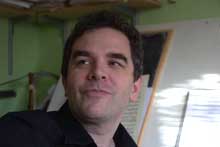
C:T talks to David Bruce, composer and founder of CompositionToday. David is currently under commission to Genesis Opera Foundation for a full-length opera, Push!, and has recently completed the score for leading theatre company Trestle’s latest success, The Smallest Person.
 |
|
David Bruce
|
Tell us something about your background.
I studied at Nottingham University, then at the Royal College of Music (including George Benjamin’s excellent all-day classes) and finally did a PhD at Kings College London under the supervision of Sir Harrison Birtwistle.
How did you start composing?
I loved music from a very young age. I vaguely remember being obsessed with Elgar’s Pomp
and Circumstance as a four year old. I then wrote pop songs for a few
years until my early teens, when I started writing for the various
school ensembles that were available.
I wrote a few brass pieces, and my magnum opus, an orchestral epic called Life in C
sharp, which displayed minimalist influences - lots of C sharps. The tragedy was that the music teacher was,
shall we say, not that committed to new music, and even though there was a perfectly
capable school orchestra, I barely had 10 minutes of a run-through of that – no performance.
Who or what has influenced your style?
I developed as a composer under the varied influences around in the early 1990s at the Royal College of Music in London. Shortly before I started that course I went on a summer school course in Dartington with Per Norgard, which had a tremendous effect on me, I think above all in terms of ambition of thought. Per is one of those people for whom the world is a vast and magical playground full of new things to explore and dreams to dream. His approach to life really fired me up and made me realise it was the artist’s duty to conjure up impossible visions and set the world ablaze.
After that came George Benjamin who also brings a tremendously infectious ferver to his view of music. Through that world I got to know the music of the French school of Spectral composers like Gerard Grisey and Tristan Murail and certain of their attitudes to sound have stayed with me. Then at King’s College, London I spent four years under Harrison Birtwistle’s supervision and he was another great influence, particularly in terms of confidence and the sense that you must listen to and trust your own inner voice.
Finally over the past few years I have been lucky enough to get involved in writing opera,
and the first two ten minute pieces I did for Tête à Tête
brought me in to contact with their artistic director Bill Bankes-Jones.
He, together with the world of opera in general, influenced me quite a lot in my attitudes towards performance and the need to set up situations which will directly grab the audience. The comparison of his lively and vivid shows with the often staid world of contemporary music performance was something of a revelation. Here was something I believed in, but that people actually enjoyed!
Where do your ideas come from?
I usually have a strong sense of some instrumental textures, the sort of imagined grittiness of real instruments. After that I focus on finding a musical structure that grabs you. I find the problem so many composers have is they can write a couple of minutes of interesting stuff and then you just lose track and find yourself wondering why this bit comes after that bit. That never happens with Beethoven. With him you always know as clear as daylight “right, we’re on the home straight now” or whatever. I don’t have any magic formula for structure, I just work on instinct. But it means I find it very hard to understand composers who map out an abstract form in advance and then fill it in. For me that just wouldn’t work.
Do you have particular techniques - one's you come back to again and again? Tell us a bit about them.
It’s a bit of a strange one, but I have had an on-going interest in a kind of long-term downbeat. I wrote a piece called Contradance which attempted to have a downbeat every 5 seconds, but fill in the 5 second space in hundreds of different ways, including rits and accels. It’s also connected with Indian music and the device they use to repeat a pattern in such a way that the last note of the pattern coincides with the downbeat – terekeetata terekeetata terekeetaTA – I always loved that for some reason.
I suppose the real answer though is no. “Techniques” have never really worked for me – I always felt like I was cheating when I used them. There is definitely a consistency in what I write – quite a few people have said they can recognise my sound – but I prefer to keep myself slightly removed from understanding what that ‘consistency’ really is. I like pretending I’m a free spirit I think.
What's the worst thing about composing?
Hearing your piece in terribly rushed conditions, no time for corrections or amendments, and knowing that may be the only time you ever hear the thing at all.
And the best?
Hearing something that actually works how you thought it would. Hearing something that really ‘takes off’ and realising – I did that.
What inspires you to write?
Other music. I often go away from a piece of Janacek or some Klezmer music reinvigorated with a passion to write something. The best moments are when you feel you’ve just written something that captures that same level of energy.
What advice would you give to a young composer just starting out?
The starting point for a piece should be something you really love. If you base the rest of the piece around that idea
you won't go far wrong. And I think it's important to love the sound of the music, rather than the idea or the concept. I
think it's very easy as a young composer to be overly influenced by grand talk and big ideas - the reviewer or the
textbook that describes the most extraordinary piece that was ever written - as a young composer its easy to allow yourself to be persuaded
by such talk even if you don't believe it in your heart. So focus on sounds you love above everything else.
Do you have a routine? A place that's special
From time to time I try to impose a routine but it never works. Inspiration is a fickle beast, I wish I could tame it. I’m looking forward to having an idyllic composing hut at the foot of the garden, but I guess I’m happy enough in my converted garage for now.
Do you do other work as well as composing?
Well yes, I run a website called, erm… www.compositiontoday.com as well as several others. I got into web work a few years ago. These days I’m lucky to be able to work for myself from home, which sits very comfortably alongside my composing – it means if Inspiration does happen to come calling I can just turn my chair around from the computer and the piano is right there.
What are you working on at the moment
I'm deep into my first full length opera Push! which is set in a labour ward. I'm working with playwright Anna Reynolds and we've just got to the stage where we're pretty sure we've nailed the main planks of the piece in place. That's a good feeling.
Interview by Composition:Today © Copyright 2004-2026
 Comments by other Members Comments by other Members
| |
|
|



