|
|
 |
Alarm Will Sound Interview
Posted on 14 December 2007. © Copyright 2004-2026
Composition:Today
|
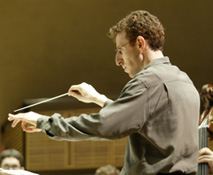
C:T talks to Alan Pierson, conductor and founder member of Alarm Will Sound, a 20-member band committed to innovative performances and recordings of today's music, who recently premiered John Adams's 'Son of Chamber Symphony'
 |
|
Alan Pierson
|
Tell us something about your background.
I honed in on a music career much later than most of my colleagues. I started playing and composing when I was around six, but I was always just as interested in things like science, literature, math, screen writing, improv, coin collecting, and on and on.... I was about 20, I think, when I realized I was headed for a life in music -- though I was still working my way through a physics degree at MIT at the time -- and nearly 25 when I started to think of myself as a conductor. I have mixed feelings about having such a diverse background. On one hand, I think it helps keep my imagination and my thinking expansive, and the broad scope is a good balance to my tendency towards tunnel vision. But I do find myself returning to basics a lot as I try to improve my craft and skills. And I wonder if some things that I struggle with would come more easily if I'd been devoted to music and conducting at an earlier age.
Tell us about Alarm Will Sound, how it was formed, and its raison d'être.
We all started playing together in various groups at the Eastman School of Music in the late 90s, and the work that we were involved in there through an organization called Ossia was starting to break out into the professional world -- we'd made this recording of Reich's Tehillim which Cantaloupe wanted to release; Nonesuch had contacted us about recording another Reich work; and Miller Theatre was interested in having us down to New York for a big show. So we suddenly started feeling that this thing we'd been doing with Ossia was something we shouldn't stop when graduation day came. And so we formed Alarm Will Sound as a way to build on what we'd been achieving together as students.
In many ways, Alarm Will Sound became a very different organization than Ossia -- which still exists as a student run organization at Eastman. But certain principles of what Alarm Will Sound does were there nascently in the programs I developed with Ossia. Ossia was entirely volunteer, and with so much happening around Eastman, it was really only possible to entice players to participate in concerts -- and many of those Ossia productions demanded a great many players! -- if the concert felt like a major event. You couldn't gather players for just an ordinary here-are-four-cool-pieces sort of concert. And it became clear that the sense of investment that the players had -- we used to rehearse those Ossia concerts endlessly! -- and their feeling of connectedness to the music and to one another made a major impact on the audience.
And that's really core to what AWS has come to be about. We try to make each program a special kind of event, and it's important that we are all involved in the music and the experience of making it together and that we convey that. A lot of what we do comes out of those those principles. AWS is really about the musicians -- because we only get that kind of imaginative programming and those sort of committed performances when everyone is deeply involved in what we're doing on stage.
You are about to premiere a new John Adams piece - tell us about the piece and how that came about.
John came to hear us play a concert of his works at Miller Theatre several years ago. We've been playing everything he's written for our instrumentation and then some -- we've arranged a few other pieces of his for ourselves to expand the repertoire a bit. And he was particularly taken with and enthusiastic about our performance of Chamber Symphony. We needed some guidance from him to make sense of some of the other work, but we already had our own unique and successful take on on Chamber Symphony, and he really liked it.
Adams's original Chamber Symphony is one of my favorite pieces for the AWS instrumentation, and it's music I feel a very deep, very intuitive connection to. I remember finding its density inpenetrable and a little alienating on a first listen back around 1995, but when I first sat down with the score a few years later, the music jumped off the page at me, and I developed an approach to the piece that grappled with that incredibly density which had so struck me at the first encounter.
The new piece came about entirely on Adams's initiative -- he just said to me that he wanted to write us a piece, and within weeks, he had arranged the commission and the premiere venues. We were just totally thrilled. Having Adams write a follow up work for Chamber Symphony was hugely exciting on its own; that he was writing it for us was almost unbelievable.
The work is quite a bit different from the original Chamber Symphony. The first movement is the closest to those roots, though it's leaner and more focused than the original. It doesn't have the manic, zany energy or its predecessor, and it's got this funky groove which reminds me more of Scratchband, another work of his that we play. But I think it's very fresh and original. The whole thing is built out of this very basic rhythmic motive from the scherzo to Beethoven's ninth symphony, and it's got this taut energy and construction which is just fabulous!
The second and third movements draw on other parts of Adams's output. Adams has this totally individual way of spinning out a seemingly endless melody which never quite settles, never quite repeats itself, but is always built out of the same basic ideas. He's done this very successfully in the opening movement of Naive and Sentimental Music -- another of his truly great works -- and the gorgeous final movement of Gnarly Buttons. The second movement of Son of Chamber Symphony is built on a lovely melody in this tradition. The third movement goes back even further -- to the irresistible rhythmic force and massive shifting harmonies of his music from around the time of Nixon in China. He's never done anything like this for our instrumentation, so it's great to get a taste of this kind of Adams action.
Does the group focus on playing specific types of music?
No -- we try to keep our vision broad. The players in the band have very eclectic tastes and that gets reflected in our programming. One of the great things about music now is the incredible range of what's going on, the sense that all of these different scenes are speaking to one another. And one of the major arguments that Alarm Will Sound puts forward in its programming is that you can take great works from all different traditions and put them side by side in a meaningful, compelling way.
How do you go about programming your concerts?
We start with an idea or concept which comes from me or one of the other members. Than there's a period of group brainstorming in which we try to explore the idea as fully as possible. That usually churns up a ton of material. Then I'll work with a committee of ensemble members who are particularly interested in that project to refine and hone all of the possibilities on the table into a coherent -- and hopefully not too long! -- program. And then that goes back to the whole ensemble for further input before we settle on a program. And even as we're touring a show, we'll often make some subtle tweaks -- changing the program order, making adjustments to the staging, etc...
How do you respond to unsolicited work- do you give feedback? Do you ever commission new work yourself?
We've never been able to program an unsolicited piece -- we don't do the kind of here-are-four-cool-pieces programs that let you easily toss in a neat work that you turned up under a rock. And our commitment to our own composers -- there are a bunch of them in the band, and they're very talented -- make it particularly hard to find opportunities for other lesser known composers. But I do try to respond to every piece I'm sent, though I always make it clear -- before listening! -- that there's no real possibility of AWS programming it.
We've premiered works by quite a few composers at this point --- David Lang, Augusta Read Thomas, John Adams, Michael Gordon, Wolfgang Rihm, as well as our own composers -- and we've been involved in all of these commissions, though the actual funds have always come from other (very generous!) organizations.
What do you see as the role (intended and actual) of new music in the modern world?
I want to create incredible experiences. I want to move people. This is ultimately my goal in everything I do, with every ensemble I work with. Lord knows I don't always succeed. So in this general sense, I don't see new music as having a role any different from that of music generally. But if you're looking to create new experiences, it's natural to look towards new music-- though I've had some of my most powerful concert experiences with very standard repertoire.
Is it a good time to be running a new music ensemble?
I think it's a great time from an artistic point of view. There are just so many possibilities. My comments earlier on the diversity and openness of the music scene today speak to this. But from a financial point of view, it's tough now: AWS really runs on a shoe-string, though we're trying to improve that. I sometimes feel like I'm at an enormous buffet with a very small fork.
What advice would you give to a young composer just starting out?
I'm still trying to find my own way and figure out the world. I wouldn't presume to advise others yet!
Tell us about the Ensemble's current projects
Right now, we're touring this concert called A/Rhythmia, which will also be a CD on Nonesuch. It's all music which involves some sort of simple groove or pulse which is warped or complexified somehow, and the pieces come from all different traditions -- European modernism, electronica, early music, rock, etc.... We're also developing a big music theater piece called 1969 which is about the we-can-change-the-world spirit of the time, told through a story centering on a meeting between John Lennon and Stockhausen that was scheduled but never actually took place.
What are your plans for the future?
We're planning a big modernist CD next. Our performing repertoire is very varied, but our recording presence has emphasized music connected to popular traditions: Reich, Aphex Twin, Michael Gordon. So we're looking to do something which leans towards other ends of what we do together.
The group has also been doing a lot of theatrical work -- everyone in the group has had to memorize music, sing and play, perform choreography, etc... -- and we're looking to develop a large-scale theater piece which takes this to the next level -- a music theater project, probably involving multimedia elements, in which the members of the band perform all aspects of the work.
How can people find out more about you?
Well, they can find out about AWS through the ensemble's website, its concerts, and its discography. I don't know how how to tell people to find out about me! I don't have a web site. They'd have to come over for dinner.
Interview by Composition:Today © Copyright 2004-2026
 Comments by other Members Comments by other Members
| |
|
|



