|
|
 |
Aaron Siegel Interview
Posted on 01 September 2007. © Copyright 2004-2026
Composition:Today
|
C:T talks to contemporary classical and jazz composer Aaron Siegel
 |
|
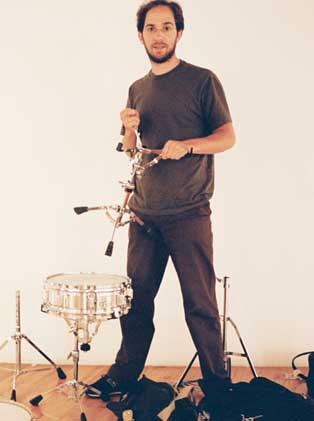
Aaron Siegel
|
Tell us something about your background.
I grew up in the suburbs of Washington DC. My musical life was centered on an intimate percussion studio in my neighborhood where the teacher there had all of her students play in percussion ensembles together. My friends and I would go into the city and play at jazz jam sessions on the weekends and eventually I went to the University of Michigan to get a degree in jazz studies. I have always wanted to be involved in diverse range experiences as a creative person, so I have always composed for my own ensembles and produced concerts of my music. I have a Masters Degree in composition from Wesleyan University and currently live in Brooklyn, New York.
How did you start composing?
As a teenager, I had a wonderful mentor named Nora Davenport. She was a percussionist in the National Opera but she was a composer as well. She was always bringing new sketches of her music into our percussion ensemble rehearsals and we would finish writing the pieces as an ensemble. Since I didn’t know any better at that time, I assumed composing was a daily part of every musical life.
What drives your work, what are you passions?
As a listener, I enjoy work that is puzzling and abstract. Not for its own sake, but because it is clear that the composer had to write the piece that way, that their own idiosyncrasies didn’t allow them to do otherwise. My work comes from this same place. I am passionate about sticking to a vision and discovering the new questions generated by my intuitive process.
How do you compose? Do you sketch? Do you composer at the instrument or away from it?
Growing up I remember being told to practice X amount of hours a day. I was terrified by this. It would have been so much better for me if I had been told to grow my relationship to music every day; jot down ideas as they come up, experiment with short pieces that your friends can play, and think critically about the results. I am working on any number of compositions at a given time. Some of them are just ideas, some have instrumentations, some come out at the piano as a sequences of pitches that I orchestrate later, and some come out fully formed, written in pen and are simply copied into a final version later.
Which non-musical influences have affected your music most?
I am inspired by art that is engaged in experimental investigations. For Virginia Wolff the novel was simply the means by which she was able to communicate. Without the need to adhere to novelistic convention, Wolff was left with the possibility of conceptualizing characters and a narrative form to serve her ideas. In the films of Werner Herzog, characters, narrative, images are only the skin on a structure of ideas. Instead of giving us something that we might relate to immediately, Herzog forces us to linger with images in uncomfortable but meaningful ways.
What is your musical philosophy?
With all of the adaptations and post-modern recontextualizing that is prevalent in a lot of art currently being made, it’s hard to remember that there is true merit in original ideas. I don’t mean to sound all grand about this (I am partial to the idea that there isn’t much left to surprise us with), but I think that there are still different perspectives on the way the world works and they should be taken on their own terms, not in reference to something else.
Who has been the greatest influence on your musical style to date and why?
I feel very indebted to the work of Morton Feldman. Up until his death, he continued to believe in the power of live music with acoustic instruments and I find that dedication quite inspiring. There is a lot to say about his harmonic language and orchestrations and I find his rhythmic notations sublime. In my mind, he changed the paradigm of notation. For him the notation really served the feeling of the music. And his pieces are so challenging and rewarding to performers.
What's the craziest idea for a piece you've ever had?
I once got together thirty people and gave them each a four-foot tube and a marble. We stood on a wooden stage and I asked them to drop the marble through the tube onto the floor. When all of the marbles hit the floor they made a beautiful splattering sound. Each of the performers picked up their marble at a different time (this made for a lovely view from the audience) and then dropped their marble again roughly ten seconds later. We repeated this cycle of activity for around 8 minutes. It was a powerful experiment in collective action and the subtle differences amongst seemingly static gestures.
What inspires you to write?
Most of the time I write from a completely uninspired place. I often get inspired only after I write things down. Looking at a page of material is much more inspiring than anything else. Then there are real questions to ask and problems to solve.
What are your plans for the future?
I am working on an evening-length piece for string quartet and four actors. The text I wrote is comprised of a series of monologues and dialogues between four family members who find it increasingly difficult to talk to one another. I have enjoyed working with a text. Words convey a special aspect of tone that is much more explicit than music. It’s also fun to play the music off of the text. Something that seems straightforward in the text can be made much more funny or sad when the music is applied in the right way. This project is going to take place at the Chocolate Factory Theater in Long Island City, Queens in May of 2008.
How can people find out more about you?
I have a website at http://www.aaronsiegel.net which contains a lot of information about my music. I would also recommend checking out my podcast at http://www.soundspeaksforitself.com. I have been posting interviews with other composers for a couple of months now and they are an interesting way to learn about new composers and their music.
Interview by Composition:Today © Copyright 2004-2026
 Comments by other Members Comments by other Members
| |
|
|



